
Review · BEIJING HUTONG TOURS
Beijing Hutong Walking Tour History, Architecture and Local Life
Beijing’s old lanes are more than a photogenic maze. On this three-hour walk, you move from Xisi through hutongs, temples and a church, then finish near the modern Financial Street district. The contrast helps you see how old Beijing sits alongside the city’s present-day center.
I like two things in particular: the range of places packed into a short route, from a Chinese-style church to a Yuan-era brick pagoda, and the chance to ask about daily life as you walk through a lived-in hutong. Guides named Lori and Dee have led tours, and the experience includes a traditional Beijing drink plus practical tips on food and getting around.
One consideration: this is a walking tour, and its three hours include the time between stops. The Temple of Previous Dynasties is visited only if it is open, so the exact experience can vary.
What makes this walk worth your time
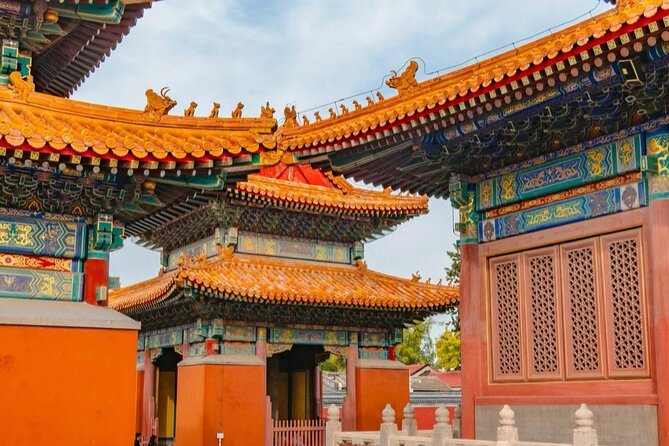
- A church, temples and a pagoda give you a broad look at Beijing’s religious and architectural past.
- Zhuanta Lane offers a walk through one of the city’s oldest hutongs, with a chance to notice the daily rhythm of the neighborhood.
- The Yuan-era Wansong Brick Pagoda adds a specific piece of history to the route, rather than leaving you with only general impressions.
- A group capped at 10 gives you more room to ask questions and keep pace with the guide.
- Water and a traditional Beijing drink are included, along with restaurant suggestions and travel advice.
- The tour links old Beijing to modern Financial Street, making the route a useful introduction to the city’s contrasts.
From Xisi into old Beijing
The meeting point is near Xisi Subway Station in Xicheng District. From there, the route leads through a part of Beijing where historical buildings, religious sites and everyday neighborhood streets sit close together.
The tour’s central appeal is its variety. In a single morning or afternoon, you can see a church with Chinese design touches, a traditional temple, a courtyard house, a hutong and a white stupa. A guide gives you context that can be hard to pick up when you are moving through the city on your own.
The walk is also designed as a quick orientation. If this is your first visit, the guide’s recommendations on restaurants and local transport can help you make better choices for the rest of your stay. If you already know Beijing, you may still appreciate the close focus on a compact area and the chance to ask about the buildings as you pass them.
The group limit of 10 is a practical plus. It is small enough for a more conversational walk, though you should still expect to share the guide’s attention with other people. This is not a private tour.
More hutong tours around Beijing:
- Beijing Hutong Walking Food and Beer Tour at Hidden Restaurants
★ 5.0 · 1,132 reviews - Temple Heaven, Summer Palace, Lama Temple, Hutong Bus Tour
★ 4.7 · 319 reviews - Temple of Heaven, Summer Palace, Lama Temple, Hutong Tours
★ 5.0 · 311 reviews
Xishiku Church and Guangji Temple
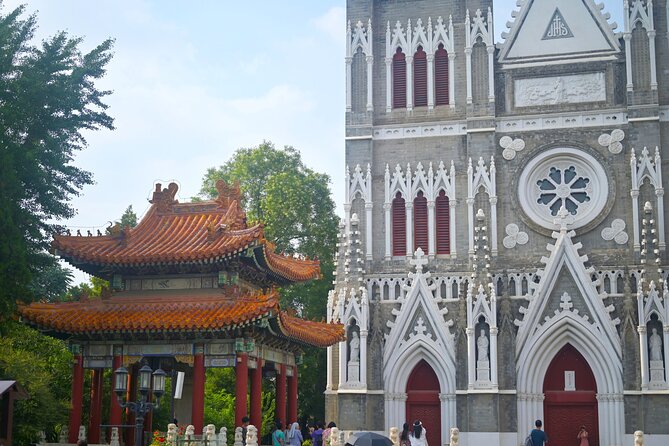
The first stop is Xishiku Church, described as Beijing’s earliest church. The visit lasts about 10 minutes and focuses on its unusual Chinese design touches and the story behind the building.
That short stop sets up one of the route’s most interesting themes: Beijing’s religious history is not represented by temples alone. The church gives you a different architectural and cultural point of comparison before the tour moves on to Guangji Temple.
At Guangji Temple, you spend about 20 minutes looking at traditional Chinese temple architecture and ancient finger paintings. The guided explanation matters here. A quick walk through a temple can leave you with little more than a visual impression; hearing what to notice gives the buildings and artwork more meaning.
The two visits complement each other well. One is a church with a distinct Chinese character, the other a traditional temple. If you are interested in how different faiths and architectural styles appear in the same city, this is a useful pairing. The schedule is compact, however, so do not expect long stretches for quiet exploration at either site.
A courtyard house and a Yuan-era pagoda
The next stop is Zhengyang Shuju, where you see the Wansong Brick Pagoda, which dates to the Yuan Dynasty, and explore a collection of old Beijing images housed in a Siheyuan. The stop is scheduled for about 20 minutes.
The pagoda gives the route a clear historical anchor. Rather than hearing about Beijing’s past only in broad terms, you get a particular structure to look at and discuss. The nearby collection of old images adds another way to think about how the city has changed.
The Siheyuan is one of the architectural forms the tour introduces. Seeing old Beijing images in this setting connects the subject of local architecture to the place around you. It is a modest but useful detail: this is not just a tour of famous facades, but a walk that also points to the forms of traditional city life.
The stop is short, so treat it as an introduction rather than an extended museum visit. If the pagoda or old photographs catch your interest, make a note of what you want to explore further during your time in Beijing.
Walking Zhuanta Lane
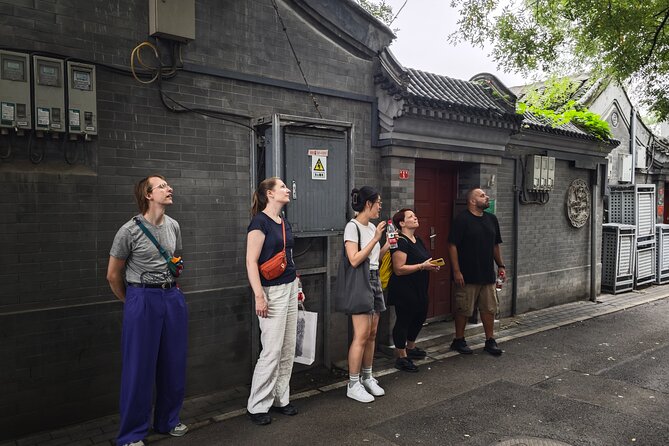
Zhuanta Lane is presented as one of Beijing’s oldest hutongs. You spend about 15 minutes walking through it, with the guide pointing out how the lane is laid out and what details, including doorways, can tell you about the neighborhood.
This is the part of the tour most directly connected to everyday life. A hutong is not simply an old street to photograph; it is also part of a living city. Walking through one with a guide helps you look beyond the narrow passage and notice how homes and lanes fit together.
The practical value is that you get a framework for interpreting other hutongs you may encounter. A guide can explain why a street is arranged as it is and why details such as doors matter, rather than leaving you to guess. The tour also asks you to respect the fact that these are local surroundings, not a set built for sightseeing.
The visit is brief, and the route cannot promise a long, unhurried look at every corner. But if you want an introduction to old Beijing’s residential texture without arranging a separate excursion, this stop earns its place.
More walking tours around Beijing:
- Private Beijing Walking Tour of the Forbidden City with 7 Options
★ 5.0 · 675 reviews - Forbidden City Private Walking Tour with Optional Sights
★ 5.0 · 400 reviews - Beijing Private Hutong Food Walking Tour
★ 5.0 · 299 reviews - Beijing: Hutong Culinary Walking Tour with 15+ Tastings
★ 5.0 · 162 reviews
The Temple of Previous Dynasties
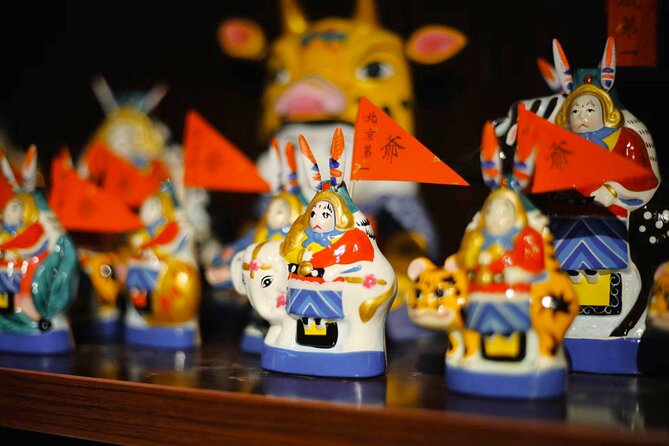
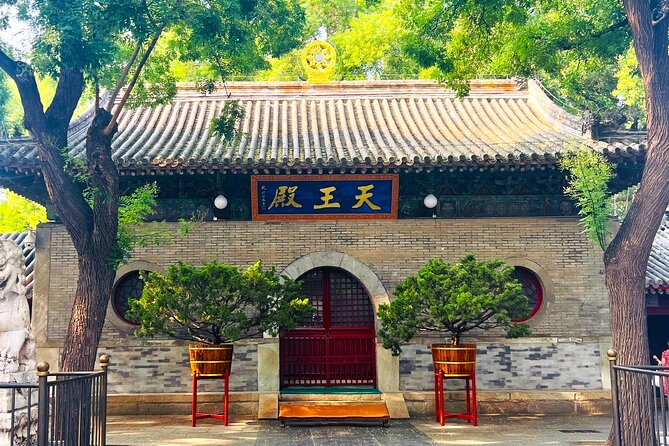
The Temple of Previous Dynasties, also called the Temple of Successive Emperors, is planned as a 20-minute stop if it is open. Here, the focus is on grand palatial structures and the Chinese tradition of honoring ancestors.
This stop adds a different scale to the walk. After the intimate lanes of Zhuanta Lane, the temple offers a more formal setting and a chance to consider how reverence for earlier rulers was expressed in architecture and ritual. The shift between small residential streets and monumental buildings is one of the route’s strengths.
The important caveat is the opening condition. The temple is not guaranteed to be accessible on every tour, so you should regard this as a possible stop rather than the fixed centerpiece of the experience. Even if it is closed, the route includes several other architectural and historical points of interest.
Seeing the White Stupa from above
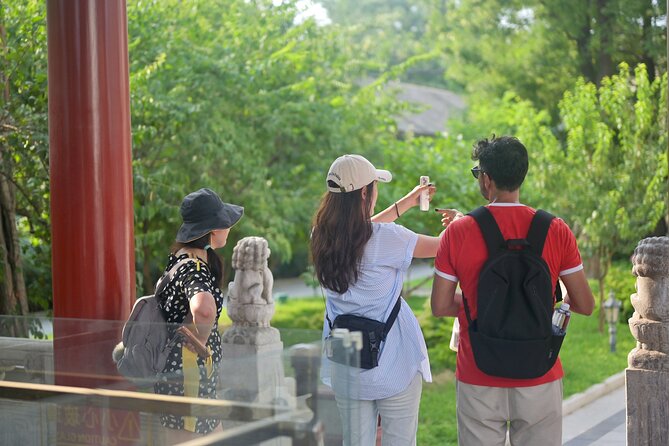
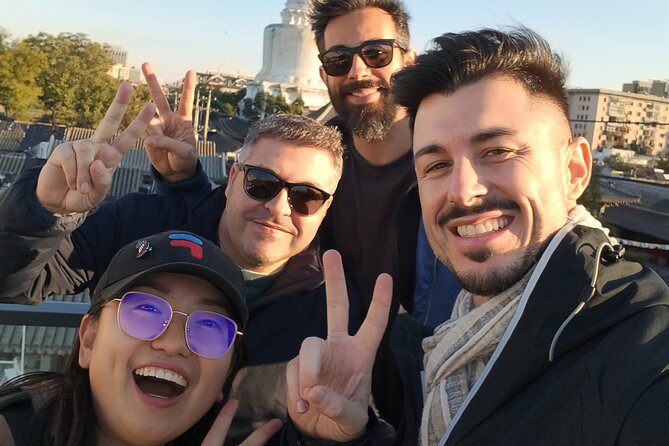
At Miaoying Temple, also known as Baita Si or White Stupa Temple, the guide shows you the exterior of the White Stupa from a nearby café balcony. The stop lasts about 15 minutes, and the guide introduces different types of Chinese pagodas.
This is a useful way to appreciate the stupa’s exterior design without treating the stop as a full temple visit. The elevated viewing position offers a clearer look at the structure, while the explanation helps you distinguish it from other forms of pagoda architecture.
Keep expectations precise: the described experience is a view from a nearby café balcony, not an extended visit inside the temple. If you want to explore the site more fully, you may need to make separate plans. Still, as part of a compact walking route, the view gives you a final architectural point to compare with the pagoda seen earlier.
Old lanes, modern Financial Street
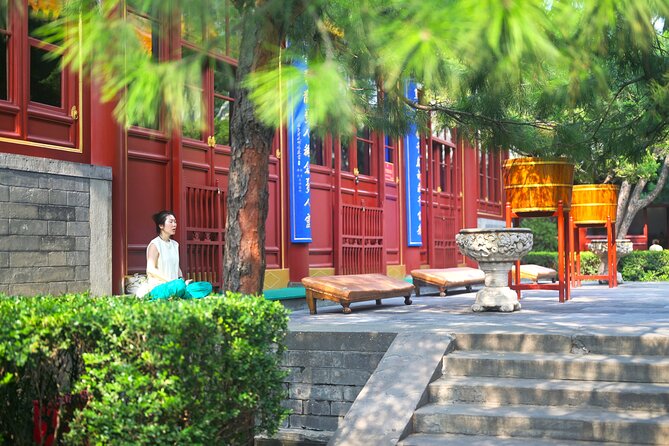
The walk ends near Exit C at Fuchengmen Station on Line 2, close to Beijing’s Financial Street district. That ending makes the tour’s old-and-new contrast tangible: the route moves through historic sites and residential lanes before bringing you to a modern business area.
The tour does not include private transportation. You should expect to move between stops on foot, and the stated three-hour duration includes travel time along the route. That is worth remembering if you are planning another activity immediately afterward.
The start and end points are in different places, so this is not a loop back to Xisi. The finish near a subway station is useful for continuing your day, but you should check your onward route before setting off. The guide can offer general travel tips, while you remain responsible for arranging your own transport.
What the $49 price includes
At $49 per person, the tour is most worthwhile if you want a guide to connect several different kinds of sites in one outing. You get a three-hour walk, a group of no more than 10, a bottle of water and a complimentary traditional Beijing drink. All fees and taxes are included, and admission is free at most listed stops; the Temple of Previous Dynasties is listed with admission included if it is open.
The value is less about ticking off a long list of attractions and more about understanding what you are looking at. A guide can explain the church’s Chinese touches, the temple architecture, the pagoda and the design of a hutong, while also answering questions about local life. That is especially helpful if you are new to Beijing and want some orientation before exploring independently.
The tour does not include private transportation. You are paying for the guided walk and its included drink and water, not a vehicle between sites. If you prefer to move at your own pace or spend an hour at each building, a self-guided visit may suit you better.
Guides named Lori and Dee have led the experience. Dee has been described as personable and willing to answer many questions, while Lori has been noted for explaining hutong layouts and the significance of doors. Guide assignments can vary, so treat those names as examples rather than a promise of who will lead your departure.
Who should book this walk
I would consider this tour a good fit if you want a manageable introduction to Beijing’s older neighborhoods and architecture. It suits first-time visitors who value context, as well as people already familiar with the city who want to look more closely at a compact area.
It is also a strong choice if you like variety. The route includes a church, temples, a stupa, a courtyard house and a hutong, rather than building the whole outing around one type of attraction. The small group and question-friendly format make it easier to ask about details that catch your eye.
You may want to skip it if you are not keen on walking, need a private vehicle, or prefer long independent visits at each stop. The schedule is a sequence of short visits, and the Temple of Previous Dynasties depends on being open. The tour requires good weather and a minimum number of participants; if it is canceled for either reason, you are offered another date or a refund.
Booking typically happens about 17 days in advance, so leaving it until the last minute may not be wise if your dates are fixed. Free cancellation is available up to 24 hours before the start time.
Should you book?
Book this walk if you want a compact, guided introduction to old Beijing, with practical city advice and a close look at architecture beyond the headline sights. Its best qualities are the mix of sites, the hutong explanation and the small group size. Just keep in mind that it is a walking tour with short stops, and one temple visit depends on opening hours.
FAQ
How long does the tour last?
The tour lasts about three hours. That total includes the time spent walking between locations.
How much does the tour cost?
The listed price is $49 per person.
Where does the tour start?
It starts near Xisi Subway Station in Xicheng District, Beijing.
Where does the tour end?
It ends near Exit C at Fuchengmen Station on Line 2, by Financial Street in Xicheng District.
What is included in the price?
The price includes all fees and taxes, bottled water and a complimentary traditional Beijing drink.
Is private transportation included?
No. Private transportation is not included.
How many people can join the tour?
The group is limited to a maximum of 10 participants.
Which places are included on the route?
The route includes Xishiku Church, Guangji Temple, Zhengyang Shuju and the Wansong Brick Pagoda, Zhuanta Lane, the Temple of Previous Dynasties if open, and a view of the White Stupa from a nearby café balcony.
Is the Temple of Previous Dynasties always open during the tour?
No. The visit takes place if the temple is open.
How far in advance is the tour usually booked?
On average, the tour is booked 17 days in advance.
More history tours around Beijing
- Beijing Historical Tour II including Summer Palace, Lama Temple & Panda Garden
★ 4.0 · 187 reviews - Beijing Historical Tour I – Forbidden City, Tiananmen Square & Temple of Heaven
★ 4.0 · 120 reviews - Beijing Historic City Guided Walking Tour + Calligraphy Creation
★ 5.0 · 59 reviews - Beijing Culture: Tea Ceremony, Heritage Instrument & Calligraphy
★ 5.0 · 57 reviews
Newest listings in Beijing
- Jinshanling Great Wall Small Group self-hiking tour from Beijing★ 4.5 · 6 reviews
- Small Group Mutianyu Great Wall and Ming Tombs Tour with Cable Car and Lunch★ 5.0 · 28 reviews
- Group Tour Including Mutianyu Great Wall And Buffet Lunch★ 4.5 · 28 reviews
- Mini Group: Half-Day Great Wall at Mutianyu Hiking Tour★ 5.0 · 33 reviews
- Beijing Group Coach Tour to Mutianyu Great Wall Without Lunch★ 4.5 · 6 reviews
- Private Tour: Beijing Hutong Night Walking and snacks Taste★ 4.0 · 29 reviews
- Small Group Tours to the Jingshaling Wall with Options★ 5.0 · 8 reviews
- Tai Chi or Kung Fu plus Chinese Calligraphy Learning Class★ 5.0 · 3 reviews
Beijing Hutong Tours, compared.

Beijing Hutong Walking Food and Beer Tour at Hidden Restaurants
Read our review →
Temple of Heaven, Summer Palace, Lama Temple, Hutong Tours
Read our review →


Beijing City Walk: Explore Hutongs Life and Old Beijing
Read our review →
Browse the lists this tour appears in